- Welcome to Dogs Of War Vu.

Cry Havoc! And let slip the dogs of war!

Recent posts
#21
World War II Europe 1939-1945 / Re: Retirement Finally Happene...
Last post by Zovs - September 15, 2026, 01:36:43 PMRon,
First off congratulations on your retirement! 45 years is a super milestone!
Second off, I am still here but my time has been busy, I started my own company with one employee (me, lol) and am a self-employed contractor, I am currently working for Wargame Design Studio as a programmer and game designer, dream job to say the least. Started learning programming in C/C++ back in 1997 to learn how to program board wargames, lol, worked in the corporate world until this year and finally got the job that started my programming learning experience.
Third off, looking forward the updates to WWII-e.
Fourth off, I'd say update The Middle East first. Then whatever interests you the most.
Lastly, dude you really need a new workstation!!! I picked up a very nice Dell with 64 GB of memory and 32 GBs of Video card memory for my programming station, and two 32 inch monitors, all just under 5k, and then picked upa Dell laptop for about 800.
Best regards,
Don
First off congratulations on your retirement!
45 years is a super milestone!Second off, I am still here but my time has been busy, I started my own company with one employee (me, lol) and am a self-employed contractor, I am currently working for Wargame Design Studio as a programmer and game designer, dream job to say the least. Started learning programming in C/C++ back in 1997 to learn how to program board wargames, lol, worked in the corporate world until this year and finally got the job that started my programming learning experience.
Third off, looking forward the updates to WWII-e.
Fourth off, I'd say update The Middle East first. Then whatever interests you the most.
Lastly, dude you really need a new workstation!!! I picked up a very nice Dell with 64 GB of memory and 32 GBs of Video card memory for my programming station, and two 32 inch monitors, all just under 5k, and then picked upa Dell laptop for about 800.
Best regards,
Don
#22
World War II Europe 1939-1945 / Re: Retirement Finally Happene...
Last post by schwerpt - September 15, 2026, 03:58:50 AMStatus on scenario #98 development: I have completed all of the Axis ground units. There are 453 located in Courland, East Prussia, Ruhr pockets, Northern Italy and internal German ground. Heinrici is commanding the German units between the Russians and Berlin. I have started the Russian units next, which will take me some time to complete.
#23
Games Discussion / Re: Warlord: Awaji - Lead a sa...
Last post by Asid - September 15, 2026, 12:04:33 AMTrading Improvements
Sat, September 12, 2026
New Player Experience, Balancing Adjustments
Warlords,
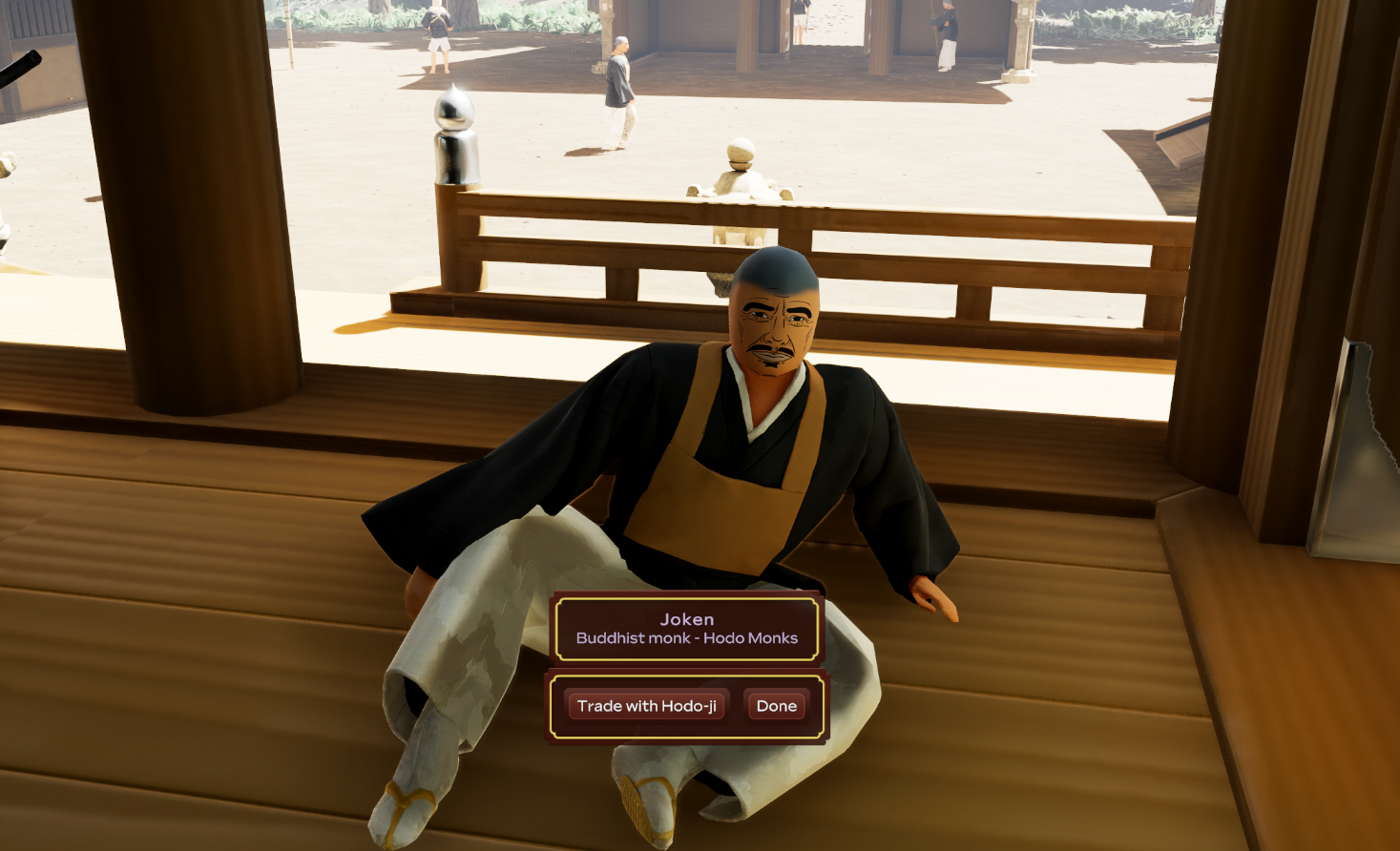
After yesterday's patch, I still felt like something was missing from my original design intent with this game. Way too many players seemed to be ignoring the option to trade with monk factions. I finally realized that this was not because they didn't find it interesting or useful, but because they simply had no idea you could do it! Beta testers were told ahead of time that it was possible, so that raw first-time-user experience was lacking. The only way to discover trading was to get lucky and have your mouse over a temple marker on the map while it was discovered.
This morning's patch is designed to bring this immersive and useful feature to light. I have included a few other improvements here as well. Like I said in the previous post, I will be continuing to monitor for any more growing pains, but honestly, I need to rest today and tomorrow, this has been a crazy week!
When I return from the wedding on the 22nd, I will dig into mid/late game optimization and battle size scaling. These two items are intertwined. Want larger battles in the end regions? Performance must be locked in. So I will take care of these in tandem. Optimization in a full open-world simulation game such as this is very nuanced and risky to fix. I will take my time on this and squeeze every last drop of performance out of this engine!
I am also aware that some users are having performance issues and instability that is abnormal (not just that they are trying to run the game on low specs). This seems to be partly due to NVIDIA RTX 5000 series graphics cards. I will also investigate this issue in the coming weeks and try to come up with a solution. This may be above well my paygrade and could require even more time to fix fully. Please have patience while I sort this out! I want everyone to enjoy the game.
See here for the full list of changes I made last night and this morning. Have a great weekend on Awaji!
Darkmatter
vR104
Sat, September 12, 2026
New Player Experience, Balancing Adjustments
Warlords,
After yesterday's patch, I still felt like something was missing from my original design intent with this game. Way too many players seemed to be ignoring the option to trade with monk factions. I finally realized that this was not because they didn't find it interesting or useful, but because they simply had no idea you could do it! Beta testers were told ahead of time that it was possible, so that raw first-time-user experience was lacking. The only way to discover trading was to get lucky and have your mouse over a temple marker on the map while it was discovered.
This morning's patch is designed to bring this immersive and useful feature to light. I have included a few other improvements here as well. Like I said in the previous post, I will be continuing to monitor for any more growing pains, but honestly, I need to rest today and tomorrow, this has been a crazy week!
When I return from the wedding on the 22nd, I will dig into mid/late game optimization and battle size scaling. These two items are intertwined. Want larger battles in the end regions? Performance must be locked in. So I will take care of these in tandem. Optimization in a full open-world simulation game such as this is very nuanced and risky to fix. I will take my time on this and squeeze every last drop of performance out of this engine!
I am also aware that some users are having performance issues and instability that is abnormal (not just that they are trying to run the game on low specs). This seems to be partly due to NVIDIA RTX 5000 series graphics cards. I will also investigate this issue in the coming weeks and try to come up with a solution. This may be above well my paygrade and could require even more time to fix fully. Please have patience while I sort this out! I want everyone to enjoy the game.
See here for the full list of changes I made last night and this morning. Have a great weekend on Awaji!
Darkmatter
vR104
- Added trade with nearby settlement button to map screen
- Added ability to talk with neutral civilians (monks and peasants) to trade with their settlement
- Added note in tutorial about trading with neutral settlements
- Adding warning in tutorial to not raze the nearby homestead, as you will need its land points to continue the tutorial right away
- Added tooltip names to trade items
- Changed trade lists to sort by item cost, more expensive at the top
- Doubled gained loot if you choose to raze a settlement and forgo the land points, making razing more viable, this simulates you destructively searching for all items in the settlement rather than taking tribute and leaving
- Increased relation gain/loss for retainer and warrior captive options
- Increased ransom payouts
- Buffed temple, monastery, mansion, and estate garrisons
- Removed bush colliders
#24
Games Discussion / Re: Rise of Piracy : Action, A...
Last post by Asid - September 14, 2026, 12:25:07 AMProgress Update - Mayors / Captains.
Sat, September 12, 2026

Progress update for the Mayors Captains active development.
Ahoy Mateys!
As most of you have probably noticed the slowdown in updates over the past month! The reason being the Mayors/Captains update has finally started development!
This is one of the biggest updates in years and by far the biggest since release. Almost every part of the project is being hit with this update. Many of the scaffolding and updates since release have contained elements in preparation for this update specifically.
This has been the most expected and requested system / feature set by far.
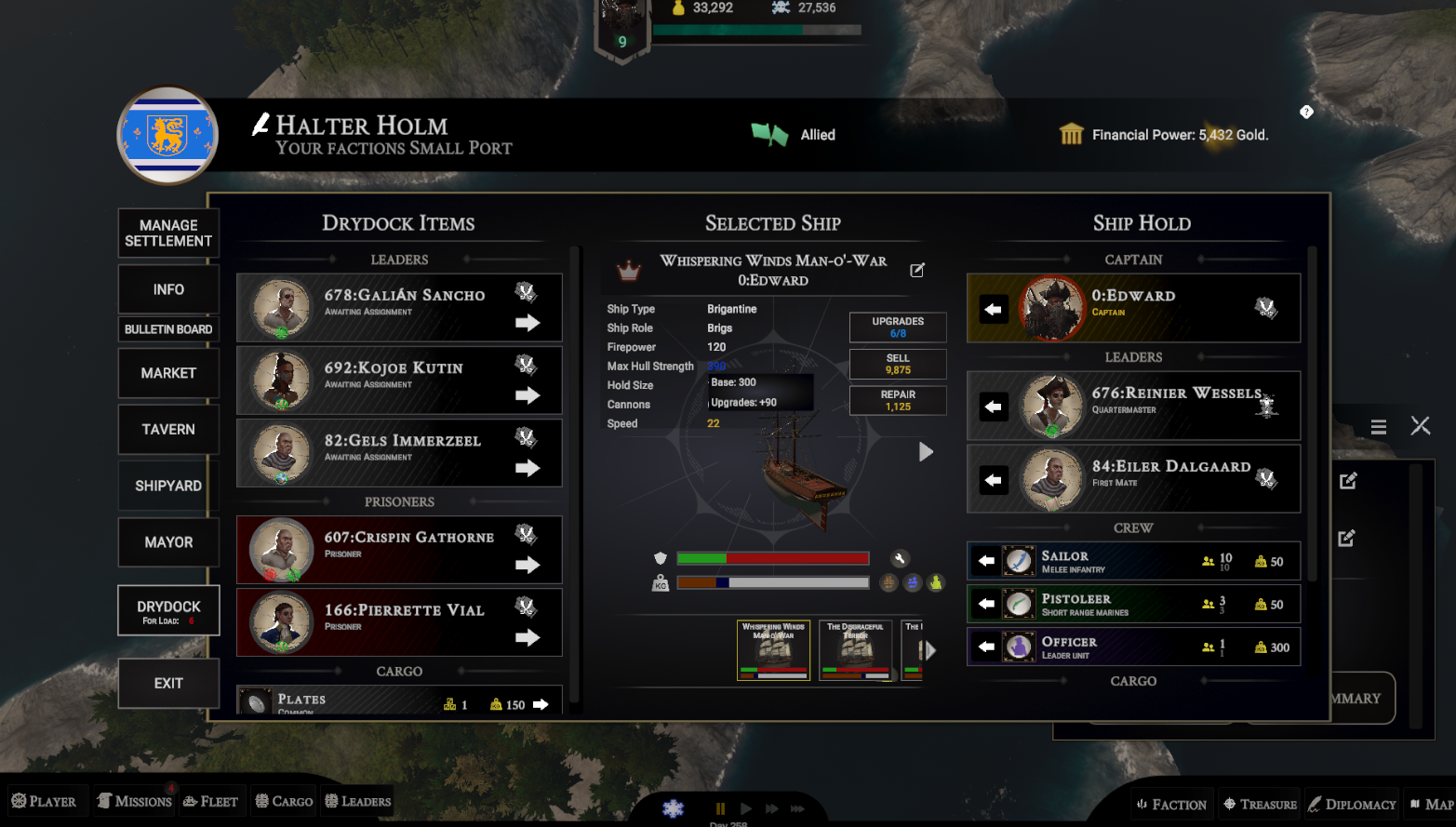
Disclaimer - a lot of programmer art & placeholders exist in the screenshots - many of the details here have not had any art pass so bear with me! I just want to fill ye in on the progress - nothing you see in the screenshots are finalized.
When its arriving
I intend to release this iteratively, with the first update arriving within a few weeks to the Test branch. In the initial update, you'll have access to the core update with the database of unique leaders taking charge of everything in the campaign.
I'm still undecided if I want to wait until the features are in a more complete state to release, or if I'll take a more partial approach like with Manage Settlement.
Existing campaigns
I'm trying to maintain backwards compatibility, so for those of you loading a long-running campaign, the first time you load in, it should set up everything and you can begin collecting and assigning captains to your fleet and islands, gaining benefits from their traits, class and bonuses. These bonuses are something you can improve on as the leaders gain experience.
Prisoner and Passenger Missions will now require a "physical" element to be transferred to your ships and protected also.
Conversational elements will arrive later and will allow you to hire these leaders and add them to your fleet as well as find out unique information and give fleet orders to your faction fleets.
Player leaders becoming captured and being wounded / killed (in hardcore) will arrive soon also.
Features
There are a bunch of things under development but the first iteration should contain some of this, depending on how the next few weeks go and testing ofc.
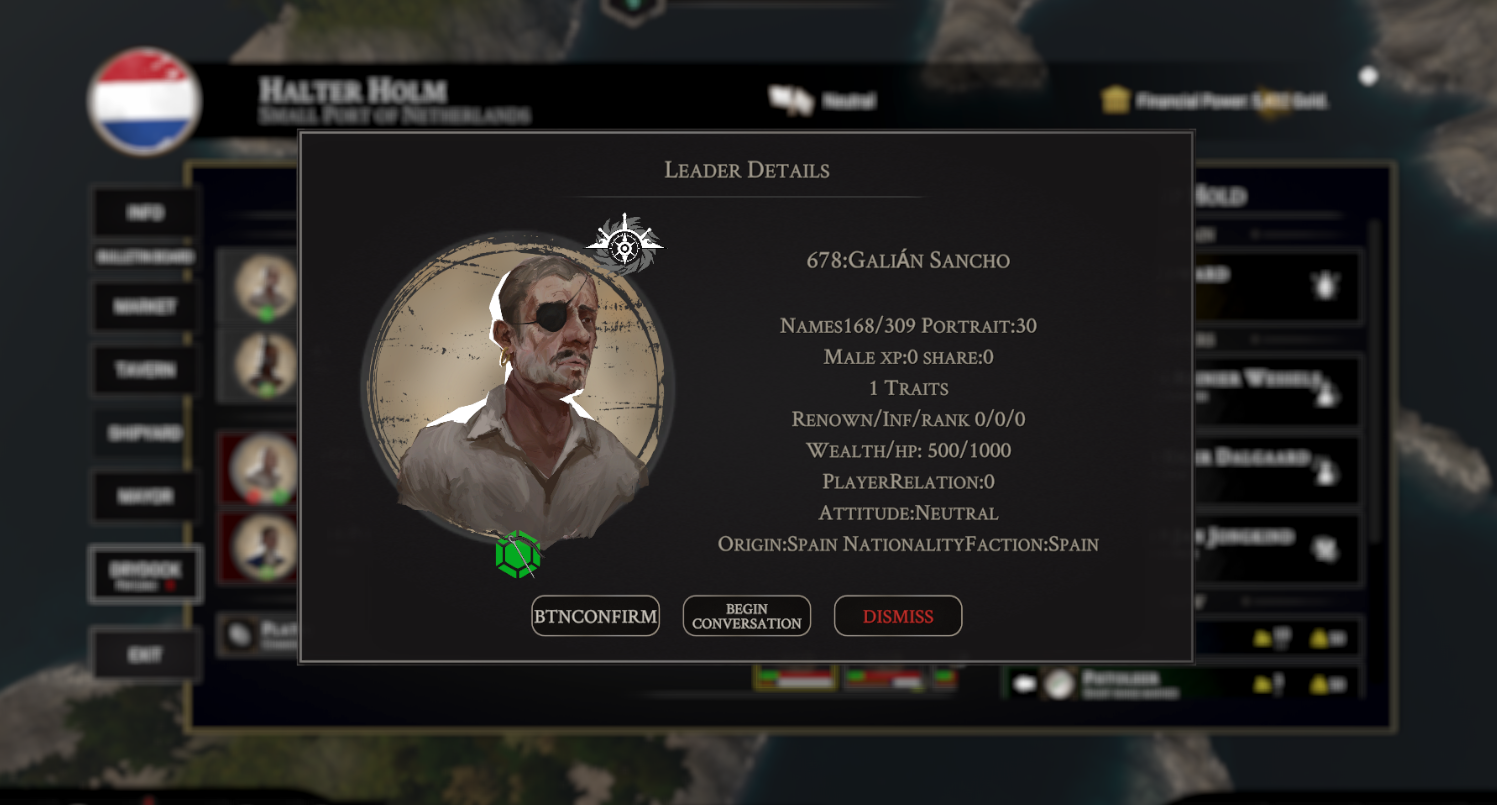
- There is a section where you can review your leaders and see where they are assigned.
The Roadmap
This work opens up a bunch of Roadmap items, with bounties and mission types probably being the most obvious. Mayors captains has been the answer to so many requests and queries by players for so long and I'm delighted to finally be in a place to get through these items.
Thank you!
Thanks to everyone that has helped with the development of this major feature, and for your patience as I put it together. So many of your feedback items, suggestions and questions have helped me plan out and understand what players want and I'm excited for the finished mechanics.
I can't imagine any of the other roadmap or major items taking quite as long to develop as this piece!
These features are still very much in active development so remember you can influence the development in the comments here, or on the discord.
Thanks folks,
John
Sat, September 12, 2026
Progress update for the Mayors Captains active development.
Ahoy Mateys!
As most of you have probably noticed the slowdown in updates over the past month! The reason being the Mayors/Captains update has finally started development!
This is one of the biggest updates in years and by far the biggest since release. Almost every part of the project is being hit with this update. Many of the scaffolding and updates since release have contained elements in preparation for this update specifically.
This has been the most expected and requested system / feature set by far.
Disclaimer - a lot of programmer art & placeholders exist in the screenshots - many of the details here have not had any art pass so bear with me! I just want to fill ye in on the progress - nothing you see in the screenshots are finalized.
When its arriving
I intend to release this iteratively, with the first update arriving within a few weeks to the Test branch. In the initial update, you'll have access to the core update with the database of unique leaders taking charge of everything in the campaign.
I'm still undecided if I want to wait until the features are in a more complete state to release, or if I'll take a more partial approach like with Manage Settlement.
Existing campaigns
I'm trying to maintain backwards compatibility, so for those of you loading a long-running campaign, the first time you load in, it should set up everything and you can begin collecting and assigning captains to your fleet and islands, gaining benefits from their traits, class and bonuses. These bonuses are something you can improve on as the leaders gain experience.
Prisoner and Passenger Missions will now require a "physical" element to be transferred to your ships and protected also.
Conversational elements will arrive later and will allow you to hire these leaders and add them to your fleet as well as find out unique information and give fleet orders to your faction fleets.
Player leaders becoming captured and being wounded / killed (in hardcore) will arrive soon also.
Features
There are a bunch of things under development but the first iteration should contain some of this, depending on how the next few weeks go and testing ofc.
- As mentioned, Leaders will have a set of core skills and traits that you can build upon as they level up. Some will be much better at governing settlements than leading a ship or crew into battle. Currently, 40 of these traits are available.
- Manage Settlement -> Governance is getting a major overhaul, centered around the governor.
- Assignment to Ships / Islands. Not just the Captain, but any leaders added to a ship will effect its stats. This system is done in the same style as the Drydock.
- Faction Overview -> It feels like the perfect time to open this up, with the faction leader being the core of your faction, initially becoming the character that you created when first creating your campaign.
- There is a section where you can review your leaders and see where they are assigned.
- Details views and popups.
- New Naming conventions.
- Origin factions for each leader. (This will come into play a bit more after conversations are implemented).
- Capturing and ransoming / indoctrinating leaders.
- Mission enhancements - Especially Transfer missions.
The Roadmap
This work opens up a bunch of Roadmap items, with bounties and mission types probably being the most obvious. Mayors captains has been the answer to so many requests and queries by players for so long and I'm delighted to finally be in a place to get through these items.
Thank you!
Thanks to everyone that has helped with the development of this major feature, and for your patience as I put it together. So many of your feedback items, suggestions and questions have helped me plan out and understand what players want and I'm excited for the finished mechanics.
I can't imagine any of the other roadmap or major items taking quite as long to develop as this piece!
These features are still very much in active development so remember you can influence the development in the comments here, or on the discord.
Thanks folks,
John
#25
Games Discussion / Re: Warlord: Awaji - Lead a sa...
Last post by Asid - September 13, 2026, 05:12:11 PMPost Launch Patch
Fri, September 11, 2026
Tutorial Blues, Pacing, Quality of Life
Warlords,
Thank you all for a wonderful launch week. Although it is too early to tell how the game will pan out commercially, so far I am delighted to see players thoroughly enjoying the game and embracing the new Warlord setting!
As with any new release, there are always growing pains. In the past ~48 hours since launch I have kept a careful eye on reviews, forum posts, and discord issue reports. Thank you to everyone participating in this way, I appreciate the swift feedback. I take this very seriously and work hard to address issues as fast as I can. I want everyone to enjoy this game as much as possible!
I had to move very quickly and make a series of patches over the past few days without a proper news article, so finally I will list them here for your convenience.
September 11th, 3PM (Now) - vR103
September 10th, 11PM - vR102
September 10th, 10AM - vR101s
September 9th, 10PM - vR101
September 9th, 4PM - vR100s
I will continue to monitor and make patches over the next few days. Next Thursday the 17th I am going to a friend's wedding and will return on the 22nd. After that I will be returning to Japan in early October to finish researching the Museum Mode, so my hope is that I can get the base game into a nearly "perfect" state by then!
Have a great weekend everyone!
Darkmatter
Fri, September 11, 2026
Tutorial Blues, Pacing, Quality of Life
Warlords,
Thank you all for a wonderful launch week. Although it is too early to tell how the game will pan out commercially, so far I am delighted to see players thoroughly enjoying the game and embracing the new Warlord setting!
As with any new release, there are always growing pains. In the past ~48 hours since launch I have kept a careful eye on reviews, forum posts, and discord issue reports. Thank you to everyone participating in this way, I appreciate the swift feedback. I take this very seriously and work hard to address issues as fast as I can. I want everyone to enjoy this game as much as possible!
I had to move very quickly and make a series of patches over the past few days without a proper news article, so finally I will list them here for your convenience.
September 11th, 3PM (Now) - vR103
- Improved starting region pacing by adding bows and naginata to checkpoints and temples, as well as a horse to the Iwaya clan mansion (northern tip of the island)
- Improved Hokudan region (second region) pacing by adding bows to all military settlements and horses to mansions and temples
- Be advised, the above changes only work on new save games because settlement inventories are mutated by convoys and trading. If the starter regions pacing was not an issue for you, please continue your save as normal
- Fixed glowing trees issue related to DLSS and FSR
September 10th, 11PM - vR102
- Added follower counts and icons to promote buttons
- Added discovered settlement and POI types to progress panel, a couple POIs are not included as they are easter eggs
- Changed how the unlock panel looks so now most items will be greyed out instead of hidden completely
- Changed how the camp and army inventory looks so items are greyed out instead of hidden completely
September 10th, 10AM - vR101s
- Fixed softlock in tutorial where the first contact step cannot be completed if you conquer the homestead before the step starts
- Removed language option from the in-game menu, somehow it returned (like Palpatine)
September 9th, 10PM - vR101
- Fixed tutorial soft lock when you capture the nearby homestead before setting charge and battle mode, now it is non-sequential
- Amended "capture the farm" string to be "capture the nearby homestead" to avoid confusion with which settlement to attack
- Fixed the pause menu so it does not noticeably pass time while paused
September 9th, 4PM - vR100s
- Moved the player closer to nearby homestead, to keep the tutorial focused
- Added a note in the tutorial for the player to confirm they are attacking the correct nearby homestead
- Lowered the tutorial nearby homestead distance check to 70 meters so the player must get closer to trigger it
- Increased starting resources slightly to compensate for players overbuilding in the tutorial
- Removed leftover K and J testing note debug buttons
I will continue to monitor and make patches over the next few days. Next Thursday the 17th I am going to a friend's wedding and will return on the 22nd. After that I will be returning to Japan in early October to finish researching the Museum Mode, so my hope is that I can get the base game into a nearly "perfect" state by then!
Have a great weekend everyone!
Darkmatter
#26
Games Discussion / Re: Air Defence RADAR Simulato...
Last post by Asid - September 13, 2026, 02:15:08 PMMajor Autumn Update
Fri, September 11, 2026
Voice Comms
Air Defender Changelog
Version 0.8
The biggest update to Air Defender since release, and everything since 0.7.0.0 is in it. Every pilot and controller has been re-voiced, interceptors now describe what they see, intercepts of formations and civilian traffic run through to a proper conclusion, airborne aircraft can be diverted to another airfield and relaunched, and fuel burn now scales with difficulty. Underneath sits a long list of fixes from your reports plus intercept procedure, radio, radar, save and performance improvements.
New: Full Pilot & Controller Re-Voice
Every radio call in the game has been re-recorded for realism.
- Pilots Speak Naturally: Interceptor pilots now speak their full callsign and flight number in a single natural take, with authentic British accents, across intercept, weapons, fuel, tanker and identification calls.
- Three Pilot Voices: Each sortie is assigned one of three pilot voices, so different flights sound like different people. Fox, RTB, Bingo, Joker, PAN-PAN and MAYDAY calls all use the pilot's own voice.
- Two Weapons Controllers: A second Weapons Controller now shares the watch, alternating with the first from sortie to sortie and heard through his own distinctive radio channel.
- Full BRA Calls: The Weapons Controller now opens every intercept call properly: your callsign, the Buchan station ident, a Bandit or Bogey preamble, then bearing, range, altitude in feet and aspect. Wording varies from call to call, calls pace themselves correctly at time acceleration, and picture calls reach out to 200 nautical miles.
- New Controller Calls: "New picture" when you retask airborne interceptors, a crossing call as fighters close within 30 miles, "Descend to target altitude" against low-flying targets, varied descent reports, and conflicting-traffic advisories to which the pilot responds, searches and reports visual.
- Every Airfield Named: All 61 airfields and diversion destinations, the Leeming, Leuchars and Coningsby ops rooms, all seven tanker callsigns and every compass sector in Track of Interest reports now have their own consistent voice lines.
New: Visual Identification
- Pilots Report What They See: Once a flight has called TALLY, the controller asks for identification and the pilot describes the aircraft: the operator, engines and registration, the number and type of any fighter escorts, or the Russian airframe hiding under a false callsign right down to the aerials on its back.
- Natural Registration Reads: Registrations are read as a single natural transmission for every one of the 633 civilian aircraft in the game.
New: Real 1998 Squadron Callsigns
- Authentic Callsigns: Interceptors now use the real 1998 RAF squadron callsigns for Leuchars, Leeming, Coningsby and Lossiemouth, 57 in total, with full controller and pilot voice coverage.
- Callsign Rotation: Every new sortie takes the next callsign from its base's pool, so no two flights on the same watch sound alike.
New: Formation & Reinforcement Intercepts
- One Raid, One Procedure: A four-ship intercepting a formation now acts as a single unit on the radio, with one merged call, one visual identification and one escalation ladder for the whole raid. The flight lead owns the calls and the whole flight stands down together when the target complies.
- Reinforcements Join Quietly: Later sorties joining an identified raid inherit the identification instead of repeating it. A fresh sortie sent after the first has gone home goes straight to the final turn-away-or-be-shot-down warning.
New: Civilian Landing Escort
- Escort to Touchdown: An intercepted airliner that is landing at its filed destination now gets a proper ending. The controller confirms it appears to be landing as filed and orders an escort, your interceptors follow it down, and the pilot reports the landing before returning to base.
New: DIVERT to Another Airfield
- Alternate Airfield Recovery: Airborne fighters, AWACS, Nimrod and tankers can be sent to another operational airfield with DIVERT from Active Operations or the aircraft's right-click controls, then resupplied and relaunched from the new base. Diverted pairs stay together and relaunch as a pair.
New: Interceptor Fuel & Endurance
Interceptor fuel burn now adapts to your selected difficulty setting.
- Hard: Realistic period-accurate baseline.
- Normal: Half rate, so interceptor sortie endurance doubles.
- Easy: One-tenth rate, for extended endurance in relaxed sessions.
- Warnings Unchanged: Joker, Bingo, PAN-PAN and MAYDAY warnings still trigger at the same fuel percentages. They just take proportionally longer to reach.
- Period-Accurate Endurance: Fuel capacities, drop tanks and burn rates have been reviewed across the military fleet and scale correctly with simulation speed.
New: Zombie Classification
- Zombie (Z): Confirmed aircraft from configured countries of interest are now classified Zombie, automatically on Easy and Normal and manually on Hard.
Interceptor Tasking
- SHADOW: The tasking button previously labelled ESCORT is now SHADOW, matching what the aircraft actually does.
- Clear Tasking: Active Identify, Engage and Shadow assignments are shown by a strike-through on both the tasked interceptor and its target.
- Whole-Flight Commands: BUSTER, CRUISE and ECO now apply to the entire flight, including aircraft returning to base. Aircraft refuelling at a tanker finish taking on fuel before automatically rejoining their flight's new tasking, and every member of a four-ship comes onto a new target.
- CAP Tasking: CAP orders now get a proper allocator acknowledgement naming your airfield and aircraft type, and you are told on ASMA if an aircraft cannot accept the task.
Fixes From Your Reports
Thank you to everyone who reported issues on Discord and through the feedback form. All of the following are resolved in this release.
- Boscombe Down Heritage Fighters: The Lightning F6 and Phantom FGR2 are now available at Boscombe Down from the start of every watch.
- Loading Mid-Session: Loading a save from the pause menu now restores the complete radar picture, keeps sortie radio-channel numbers in their original launch order, plays each radio call once, keeps inbound airliners heading for their destination, and preserves radar outage effects.
- Map Markers Clear: CAP, AWACS and SIGINT markers and range rings are removed from the map once the flight has returned home.
- Enemy Raids: Bomber missile volleys now fire toward their target from the first launch, and bombers no longer re-attack an empty patch of sea.
- FOX 3: Sea Harrier FA.2 AMRAAM shots now use the correct FOX 3 brevity call.
- Panels Come Forward: Clicking anywhere on a panel brings it to the front, not just its title bar.
- Airborne Asset Details: Track data for your own airborne assets stays visible and clickable throughout the watch, and a stray press of the Delete key can no longer hide it.
- Pausing Safely: A long stay in the pause menu no longer causes enemy aircraft to vanish or triggers a spoofer escape penalty.
- Fair Coaching: The ASMA mentor no longer penalises you for a hostile formation that already has an intercept committed against it.
- Automatic Stand-Down: A scramble request is cancelled automatically when its target turns back at the airspace boundary before launch.
- Disguised Aircraft Stay in Play: Deception aircraft flying under a false callsign now always complete their route out of UK airspace before leaving the radar picture, so an escort sortie runs through to its conclusion instead of ending part-way.
Intercept Procedure
- Realistic Compliance: Aircraft that comply after a warning now genuinely turn away, out toward the edge of UK airspace, and must hold that course for a sustained 30 seconds before the pilot reports them complying. Leaving UK airspace still counts immediately.
- Sensible Pursuit: Interceptors no longer chase a departing aircraft deep into Europe. Once it has left UK airspace and is clearly flying away, the flight declares it complying and returns home. Outbound targets remain on radar until well clear, so an intercept in progress can complete.
- Realistic Descents: Interceptors descend at military rates to meet low-flying targets and only call TALLY once they are actually near the target's altitude.
- Hostile Targets Conclude: Aircraft you have marked HOSTILE now get a proper conclusion: interceptors report compliance and return, or the WEAPONS HOT alert fires when the final warning is ignored at heightened tension. At Critical tension, targets already classified Hostile skip the identification calls and go straight to engagement.
- Complete Sequences: JUDY, confirm-intentions, shadowing, show-of-presence, show-of-force, turn-away, complying and RTB calls now run reliably through to resolution in every intercept route, inside and outside UK airspace, and resume correctly after loading a save mid-intercept.
- Pair Coordination: Interceptor pairs stay coordinated through retasking, low-fuel decisions, refuelling and emergency recovery, and intercept decisions no longer leave procedures waiting indefinitely.
Radio
- Live Radio: Switching onto a sortie's channel now joins whatever is being said at its live position, exactly like a real radio. Calls play only on their own sortie's channel and never bleed into unrelated frequencies.
- Once Per Flight: Controller readbacks, RTB acknowledgements, splash calls, entering-airspace alerts and escalation calls play once per flight rather than once per aircraft.
- Accurate Emergency Calls: MAYDAY, PAN-PAN and controller responses use the correct speaker, callsign and sequence across every emergency type.
- Traffic Advisories: Conflicting-traffic advisories cover only genuinely separate aircraft, never the target you are intercepting.
- Accelerated Radio: Voice sequences remain smooth, complete and correctly ordered at 2x, 5x and admin time controls.
Radar
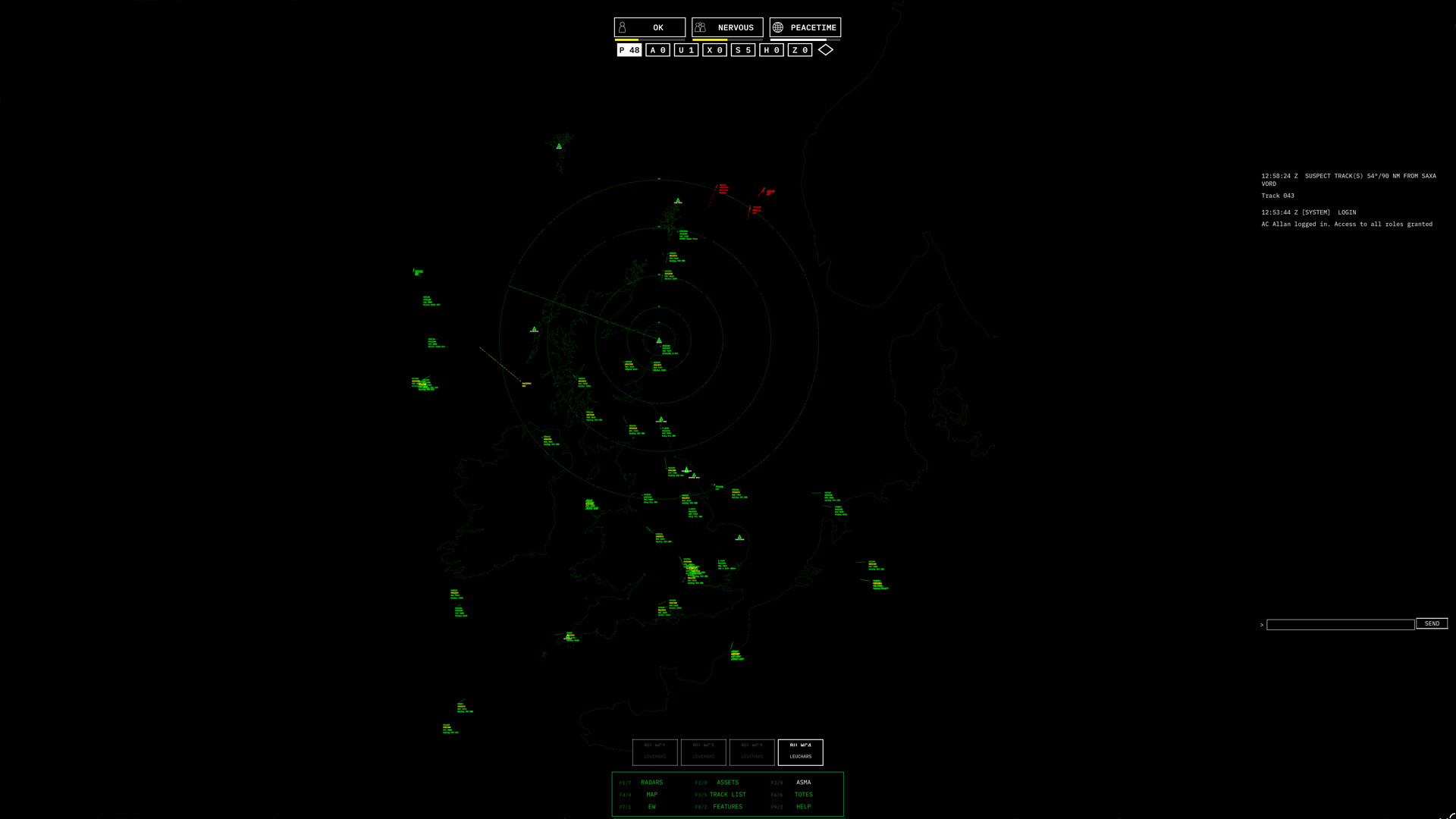
- First-Sweep Contact: A radar contact now shows a triangle from the very first sweep that paints it and becomes the usual track symbol when the track forms, so a raw detection is instantly distinguishable from an established track.
- Track of Interest Accuracy: Reports now come from the correct radar station with the correct eight-point compass sector.
- Missile Tracks: Air-to-air missile tracks display a readable type on the data block.
Enemy AI & Deception
- Role-Based Flight Profiles: Enemy aircraft and missiles now fly profiles that match their role and weapon type.
- Campaign Continuity: Enemy campaign waves and victory progress continue correctly after loading a mid-campaign save.
- Identification Discipline: Unidentified hostile aircraft remain concealed until positively identified, then update consistently across the interface.
- Deception Behaviour: Disguised and compliant aircraft restore and manoeuvre reliably after a load.
Civilian Traffic
- Dublin Airport: Irish-bound airliners now descend and land at Dublin.
- Airspace Closure: Closing civilian airspace now halts every new scheduled and offshore-shuttle departure and diverts only physical aircraft, leaving CAP markers and radar ownership untouched.
- Airborne Diversions: Civilian aircraft divert if their destination becomes unavailable while airborne, and arrivals continue sequencing normally after loading an earlier point in a busy watch.
- Civilian Emergencies: Emergency squawks, aircraft identity and radio procedures remain correct throughout an incident, and emergency intercepts clear their operations alerts when resolved.
- ATC Rundowns: ATC rundowns keep their identification choices concise.
Training Missions
- Realistic Pictures: Tunnel Vision and Needle in a Haystack now start with normal civilian traffic on the radar, so the raids and the spoof aircraft have to be picked out from real contacts.
- Reliable Progress: Training missions save and resume correctly at every stage, Weapons Hot kills are scored correctly, and mission instructions no longer carry over into the results screen or a retry.
Save & Load
- Safer Saving: Save writes, rapid save requests and damaged-file handling are more dependable, and the Load Game list opens more quickly when many saves are present.
- Operational State Preserved: Aircraft, weapons, campaign progress, emergency state, support missions, AWACS range rings, civilian aircraft identities and intercepts saved during TALLY or the warning procedure all restore and resume correctly.
- Clean Loads: A loaded watch remains paused until the menu closes, then resumes at the saved speed. Loading a different watch clears effects and alerts left by the watch being replaced, and named saves preserve scenario pacing.
Scoring
- Cruise Missile Kills: Destroying an inbound hostile cruise missile is rewarded as an enemy kill.
- Accurate Rewards: Radar-evasion rewards show the exact XP awarded for the selected difficulty.
- Persistent Statistics: Destroyed-aircraft totals and campaign progress stay attached to the correct saved watch.
General Improvements
- NADOC Critical Briefing: Plays once when Critical is first reached in each watch.
- Settings Remembered: Volume levels, map overlays, zoom, position and line width are kept as you left them between sessions.
- Interface: Escape closes only the active popup or surface, gameplay shortcuts stay inactive while typing, tasked AWACS show their departure countdown, QRA launch closes cleanly, and track, tanker, flight-information and minimised-panel displays are clearer and more stable.
- Nuclear Alerts: Nuclear missile launches now use the Emergency Alert System warning once rather than a looping alert.
- Steam Continuity: Steam and Steam Cloud remain available after returning to the main menu and beginning another watch.
- Graphics Compatibility: The UK coastline displays reliably on Intel integrated graphics.
- 1998 Accuracy: Aircraft identities, callsigns, airfields and civilian operations are aligned to a consistent July 1998 setting, period-authenticated satellite activity can appear through Fylingdales, Tornado F3 and Sea Harrier AIM-9L shots reflect their all-aspect capability while the Lightning's earlier missiles remain rear-aspect, and radar clutter positions have been reviewed.
Performance & Stability
Busy watches now spread radar, airborne surveillance, asset panel, civilian traffic and clutter work more evenly across frames, with far less memory churn during large raids, for noticeably steadier frame pacing. Many smaller fixes have been folded in along the way, invisible during normal play but cumulatively reducing the chance of rare crashes, voice cutouts, save and load glitches, and frame-rate hitches under unusual conditions.
And finally, as always, thank you so much for your support and feedback. Together we'll make this the best air defence simulator on the planet. Per Ardua, Ad Astra.
Fri, September 11, 2026
Voice Comms
Air Defender Changelog
Version 0.8
The biggest update to Air Defender since release, and everything since 0.7.0.0 is in it. Every pilot and controller has been re-voiced, interceptors now describe what they see, intercepts of formations and civilian traffic run through to a proper conclusion, airborne aircraft can be diverted to another airfield and relaunched, and fuel burn now scales with difficulty. Underneath sits a long list of fixes from your reports plus intercept procedure, radio, radar, save and performance improvements.
New: Full Pilot & Controller Re-Voice
Every radio call in the game has been re-recorded for realism.
- Pilots Speak Naturally: Interceptor pilots now speak their full callsign and flight number in a single natural take, with authentic British accents, across intercept, weapons, fuel, tanker and identification calls.
- Three Pilot Voices: Each sortie is assigned one of three pilot voices, so different flights sound like different people. Fox, RTB, Bingo, Joker, PAN-PAN and MAYDAY calls all use the pilot's own voice.
- Two Weapons Controllers: A second Weapons Controller now shares the watch, alternating with the first from sortie to sortie and heard through his own distinctive radio channel.
- Full BRA Calls: The Weapons Controller now opens every intercept call properly: your callsign, the Buchan station ident, a Bandit or Bogey preamble, then bearing, range, altitude in feet and aspect. Wording varies from call to call, calls pace themselves correctly at time acceleration, and picture calls reach out to 200 nautical miles.
- New Controller Calls: "New picture" when you retask airborne interceptors, a crossing call as fighters close within 30 miles, "Descend to target altitude" against low-flying targets, varied descent reports, and conflicting-traffic advisories to which the pilot responds, searches and reports visual.
- Every Airfield Named: All 61 airfields and diversion destinations, the Leeming, Leuchars and Coningsby ops rooms, all seven tanker callsigns and every compass sector in Track of Interest reports now have their own consistent voice lines.
New: Visual Identification
- Pilots Report What They See: Once a flight has called TALLY, the controller asks for identification and the pilot describes the aircraft: the operator, engines and registration, the number and type of any fighter escorts, or the Russian airframe hiding under a false callsign right down to the aerials on its back.
- Natural Registration Reads: Registrations are read as a single natural transmission for every one of the 633 civilian aircraft in the game.
New: Real 1998 Squadron Callsigns
- Authentic Callsigns: Interceptors now use the real 1998 RAF squadron callsigns for Leuchars, Leeming, Coningsby and Lossiemouth, 57 in total, with full controller and pilot voice coverage.
- Callsign Rotation: Every new sortie takes the next callsign from its base's pool, so no two flights on the same watch sound alike.
New: Formation & Reinforcement Intercepts
- One Raid, One Procedure: A four-ship intercepting a formation now acts as a single unit on the radio, with one merged call, one visual identification and one escalation ladder for the whole raid. The flight lead owns the calls and the whole flight stands down together when the target complies.
- Reinforcements Join Quietly: Later sorties joining an identified raid inherit the identification instead of repeating it. A fresh sortie sent after the first has gone home goes straight to the final turn-away-or-be-shot-down warning.
New: Civilian Landing Escort
- Escort to Touchdown: An intercepted airliner that is landing at its filed destination now gets a proper ending. The controller confirms it appears to be landing as filed and orders an escort, your interceptors follow it down, and the pilot reports the landing before returning to base.
New: DIVERT to Another Airfield
- Alternate Airfield Recovery: Airborne fighters, AWACS, Nimrod and tankers can be sent to another operational airfield with DIVERT from Active Operations or the aircraft's right-click controls, then resupplied and relaunched from the new base. Diverted pairs stay together and relaunch as a pair.
New: Interceptor Fuel & Endurance
Interceptor fuel burn now adapts to your selected difficulty setting.
- Hard: Realistic period-accurate baseline.
- Normal: Half rate, so interceptor sortie endurance doubles.
- Easy: One-tenth rate, for extended endurance in relaxed sessions.
- Warnings Unchanged: Joker, Bingo, PAN-PAN and MAYDAY warnings still trigger at the same fuel percentages. They just take proportionally longer to reach.
- Period-Accurate Endurance: Fuel capacities, drop tanks and burn rates have been reviewed across the military fleet and scale correctly with simulation speed.
New: Zombie Classification
- Zombie (Z): Confirmed aircraft from configured countries of interest are now classified Zombie, automatically on Easy and Normal and manually on Hard.
Interceptor Tasking
- SHADOW: The tasking button previously labelled ESCORT is now SHADOW, matching what the aircraft actually does.
- Clear Tasking: Active Identify, Engage and Shadow assignments are shown by a strike-through on both the tasked interceptor and its target.
- Whole-Flight Commands: BUSTER, CRUISE and ECO now apply to the entire flight, including aircraft returning to base. Aircraft refuelling at a tanker finish taking on fuel before automatically rejoining their flight's new tasking, and every member of a four-ship comes onto a new target.
- CAP Tasking: CAP orders now get a proper allocator acknowledgement naming your airfield and aircraft type, and you are told on ASMA if an aircraft cannot accept the task.
Fixes From Your Reports
Thank you to everyone who reported issues on Discord and through the feedback form. All of the following are resolved in this release.
- Boscombe Down Heritage Fighters: The Lightning F6 and Phantom FGR2 are now available at Boscombe Down from the start of every watch.
- Loading Mid-Session: Loading a save from the pause menu now restores the complete radar picture, keeps sortie radio-channel numbers in their original launch order, plays each radio call once, keeps inbound airliners heading for their destination, and preserves radar outage effects.
- Map Markers Clear: CAP, AWACS and SIGINT markers and range rings are removed from the map once the flight has returned home.
- Enemy Raids: Bomber missile volleys now fire toward their target from the first launch, and bombers no longer re-attack an empty patch of sea.
- FOX 3: Sea Harrier FA.2 AMRAAM shots now use the correct FOX 3 brevity call.
- Panels Come Forward: Clicking anywhere on a panel brings it to the front, not just its title bar.
- Airborne Asset Details: Track data for your own airborne assets stays visible and clickable throughout the watch, and a stray press of the Delete key can no longer hide it.
- Pausing Safely: A long stay in the pause menu no longer causes enemy aircraft to vanish or triggers a spoofer escape penalty.
- Fair Coaching: The ASMA mentor no longer penalises you for a hostile formation that already has an intercept committed against it.
- Automatic Stand-Down: A scramble request is cancelled automatically when its target turns back at the airspace boundary before launch.
- Disguised Aircraft Stay in Play: Deception aircraft flying under a false callsign now always complete their route out of UK airspace before leaving the radar picture, so an escort sortie runs through to its conclusion instead of ending part-way.
Intercept Procedure
- Realistic Compliance: Aircraft that comply after a warning now genuinely turn away, out toward the edge of UK airspace, and must hold that course for a sustained 30 seconds before the pilot reports them complying. Leaving UK airspace still counts immediately.
- Sensible Pursuit: Interceptors no longer chase a departing aircraft deep into Europe. Once it has left UK airspace and is clearly flying away, the flight declares it complying and returns home. Outbound targets remain on radar until well clear, so an intercept in progress can complete.
- Realistic Descents: Interceptors descend at military rates to meet low-flying targets and only call TALLY once they are actually near the target's altitude.
- Hostile Targets Conclude: Aircraft you have marked HOSTILE now get a proper conclusion: interceptors report compliance and return, or the WEAPONS HOT alert fires when the final warning is ignored at heightened tension. At Critical tension, targets already classified Hostile skip the identification calls and go straight to engagement.
- Complete Sequences: JUDY, confirm-intentions, shadowing, show-of-presence, show-of-force, turn-away, complying and RTB calls now run reliably through to resolution in every intercept route, inside and outside UK airspace, and resume correctly after loading a save mid-intercept.
- Pair Coordination: Interceptor pairs stay coordinated through retasking, low-fuel decisions, refuelling and emergency recovery, and intercept decisions no longer leave procedures waiting indefinitely.
Radio
- Live Radio: Switching onto a sortie's channel now joins whatever is being said at its live position, exactly like a real radio. Calls play only on their own sortie's channel and never bleed into unrelated frequencies.
- Once Per Flight: Controller readbacks, RTB acknowledgements, splash calls, entering-airspace alerts and escalation calls play once per flight rather than once per aircraft.
- Accurate Emergency Calls: MAYDAY, PAN-PAN and controller responses use the correct speaker, callsign and sequence across every emergency type.
- Traffic Advisories: Conflicting-traffic advisories cover only genuinely separate aircraft, never the target you are intercepting.
- Accelerated Radio: Voice sequences remain smooth, complete and correctly ordered at 2x, 5x and admin time controls.
Radar
- First-Sweep Contact: A radar contact now shows a triangle from the very first sweep that paints it and becomes the usual track symbol when the track forms, so a raw detection is instantly distinguishable from an established track.
- Track of Interest Accuracy: Reports now come from the correct radar station with the correct eight-point compass sector.
- Missile Tracks: Air-to-air missile tracks display a readable type on the data block.
Enemy AI & Deception
- Role-Based Flight Profiles: Enemy aircraft and missiles now fly profiles that match their role and weapon type.
- Campaign Continuity: Enemy campaign waves and victory progress continue correctly after loading a mid-campaign save.
- Identification Discipline: Unidentified hostile aircraft remain concealed until positively identified, then update consistently across the interface.
- Deception Behaviour: Disguised and compliant aircraft restore and manoeuvre reliably after a load.
Civilian Traffic
- Dublin Airport: Irish-bound airliners now descend and land at Dublin.
- Airspace Closure: Closing civilian airspace now halts every new scheduled and offshore-shuttle departure and diverts only physical aircraft, leaving CAP markers and radar ownership untouched.
- Airborne Diversions: Civilian aircraft divert if their destination becomes unavailable while airborne, and arrivals continue sequencing normally after loading an earlier point in a busy watch.
- Civilian Emergencies: Emergency squawks, aircraft identity and radio procedures remain correct throughout an incident, and emergency intercepts clear their operations alerts when resolved.
- ATC Rundowns: ATC rundowns keep their identification choices concise.
Training Missions
- Realistic Pictures: Tunnel Vision and Needle in a Haystack now start with normal civilian traffic on the radar, so the raids and the spoof aircraft have to be picked out from real contacts.
- Reliable Progress: Training missions save and resume correctly at every stage, Weapons Hot kills are scored correctly, and mission instructions no longer carry over into the results screen or a retry.
Save & Load
- Safer Saving: Save writes, rapid save requests and damaged-file handling are more dependable, and the Load Game list opens more quickly when many saves are present.
- Operational State Preserved: Aircraft, weapons, campaign progress, emergency state, support missions, AWACS range rings, civilian aircraft identities and intercepts saved during TALLY or the warning procedure all restore and resume correctly.
- Clean Loads: A loaded watch remains paused until the menu closes, then resumes at the saved speed. Loading a different watch clears effects and alerts left by the watch being replaced, and named saves preserve scenario pacing.
Scoring
- Cruise Missile Kills: Destroying an inbound hostile cruise missile is rewarded as an enemy kill.
- Accurate Rewards: Radar-evasion rewards show the exact XP awarded for the selected difficulty.
- Persistent Statistics: Destroyed-aircraft totals and campaign progress stay attached to the correct saved watch.
General Improvements
- NADOC Critical Briefing: Plays once when Critical is first reached in each watch.
- Settings Remembered: Volume levels, map overlays, zoom, position and line width are kept as you left them between sessions.
- Interface: Escape closes only the active popup or surface, gameplay shortcuts stay inactive while typing, tasked AWACS show their departure countdown, QRA launch closes cleanly, and track, tanker, flight-information and minimised-panel displays are clearer and more stable.
- Nuclear Alerts: Nuclear missile launches now use the Emergency Alert System warning once rather than a looping alert.
- Steam Continuity: Steam and Steam Cloud remain available after returning to the main menu and beginning another watch.
- Graphics Compatibility: The UK coastline displays reliably on Intel integrated graphics.
- 1998 Accuracy: Aircraft identities, callsigns, airfields and civilian operations are aligned to a consistent July 1998 setting, period-authenticated satellite activity can appear through Fylingdales, Tornado F3 and Sea Harrier AIM-9L shots reflect their all-aspect capability while the Lightning's earlier missiles remain rear-aspect, and radar clutter positions have been reviewed.
Performance & Stability
Busy watches now spread radar, airborne surveillance, asset panel, civilian traffic and clutter work more evenly across frames, with far less memory churn during large raids, for noticeably steadier frame pacing. Many smaller fixes have been folded in along the way, invisible during normal play but cumulatively reducing the chance of rare crashes, voice cutouts, save and load glitches, and frame-rate hitches under unusual conditions.
And finally, as always, thank you so much for your support and feedback. Together we'll make this the best air defence simulator on the planet. Per Ardua, Ad Astra.
#27
Games Discussion / Re: Warlord: Awaji - Lead a sa...
Last post by Asid - September 12, 2026, 04:30:57 PMPatch vR101
Thu, September 10, 2026
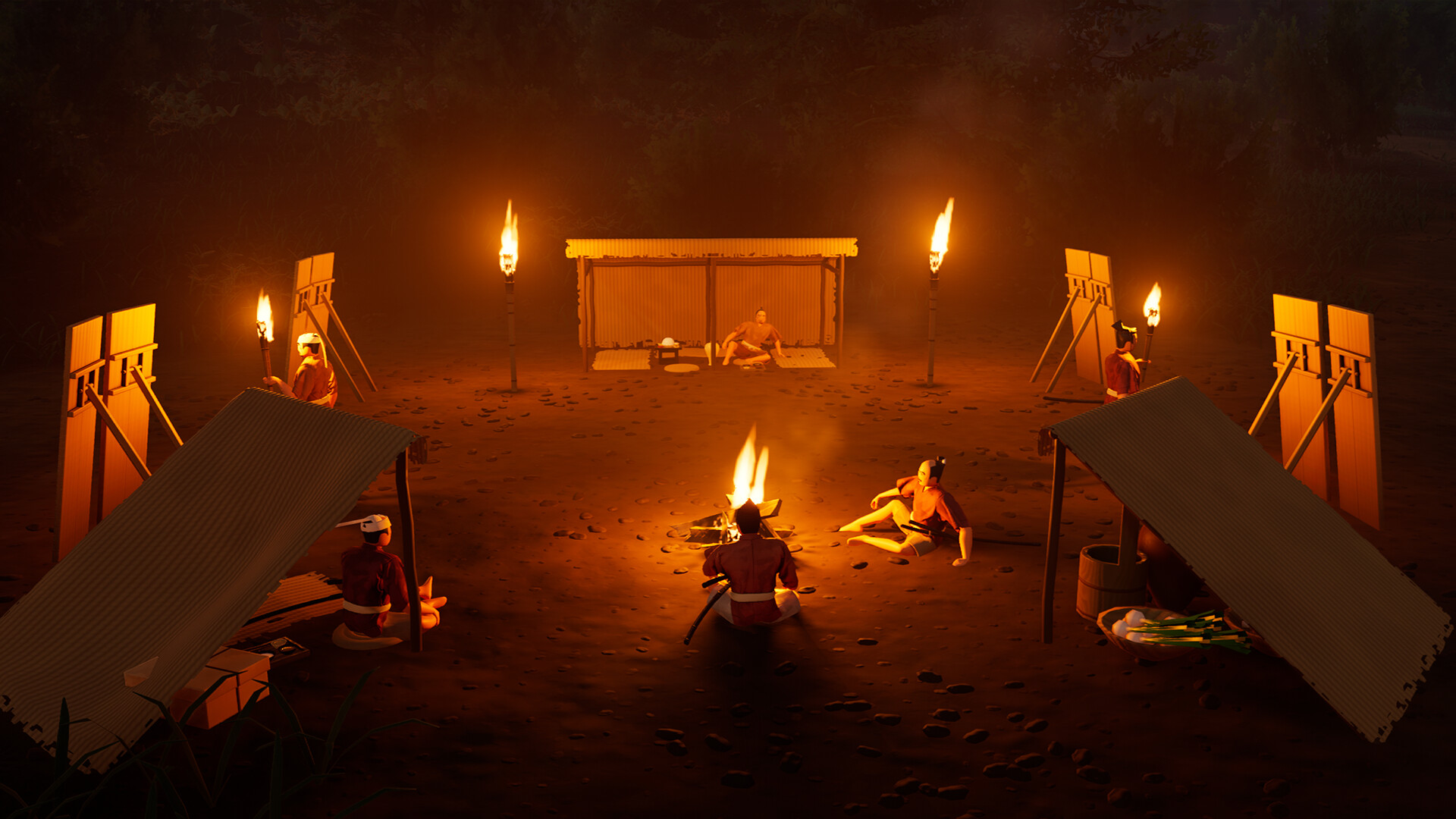
vR101
Patch vR102
Fri, September 11, 2026
Thu, September 10, 2026
vR101
- Moved the player closer to nearby homestead, to keep the tutorial focused
- Added a note in the tutorial for the player to confirm they are attacking the correct nearby homestead
- Lowered the tutorial nearby homestead distance check to 70 meters so the player must get closer to trigger it
- Increased starting resources slightly to compensate for players overbuilding in the tutorial
- Removed leftover K and J testing note debug buttons
- Fixed tutorial soft lock when you capture the nearby homestead before setting charge and battle mode, now it is non-sequential
- Amended "capture the farm" string to be "capture the nearby homestead" to avoid confusion with which settlement to attack
- Fixed the pause menu so it does not noticeably pass time while paused
Patch vR102
Fri, September 11, 2026
- Added follower counts and icons to promote buttons
- Added discovered settlement and POI types to progress panel, a couple POIs are not included as they are easter eggs
- Changed how the unlock panel looks so now most items will be greyed out instead of hidden completely
- Changed how the camp and army inventory looks so items are greyed out instead of hidden completely
#28
Games Discussion / Re: Warlord: Awaji - Lead a sa...
Last post by Asid - September 12, 2026, 04:27:58 PMWarlord: Awaji Now Available
Wed, September 9, 2026
Jump into Awaji and experience medieval Japanese warfare like never before!
Warlords,
First, a message from me:
Thank you all for the support over these past 3 years of development and even before that with Warlord: Britannia. Darkmatter Games remains a single full-time developer leading an incredibly small team of skilled contractors. Warlord: Awaji is a fully handcrafted adventure made with the utmost care and attention to detail. Darkmatter Games has no outside investors or publishers. This is all possible thanks to YOU the player!
Today marks the end of a 3 year journey for me, and the beginning of a brand new adventure for you all. I hope you will have a blast playing! Whatever happens when this game launches, rest assured I will do my best to resolve issues quickly so that the maximum amount of people can play and enjoy the game.
Second, as Warlord tradition dictates, your in-universe launch message:
The Emperor's fledgling regime is on the brink of collapse. Rebel forces have taken over Awaji Island, and their powerful leader is returning from the West with a massive army to depose our Emperor in Kyoto.
Rumor has spread that the monks and warriors on Awaji have uncovered powerful, arcane weapons from a bygone war.
You are being sent to Awaji to defeat this rebellion and uncover the truth! If there is an advantage to be gained in this war, the Emperor wants it found!
Now set forth, and make for Awaji!
Darkmatter
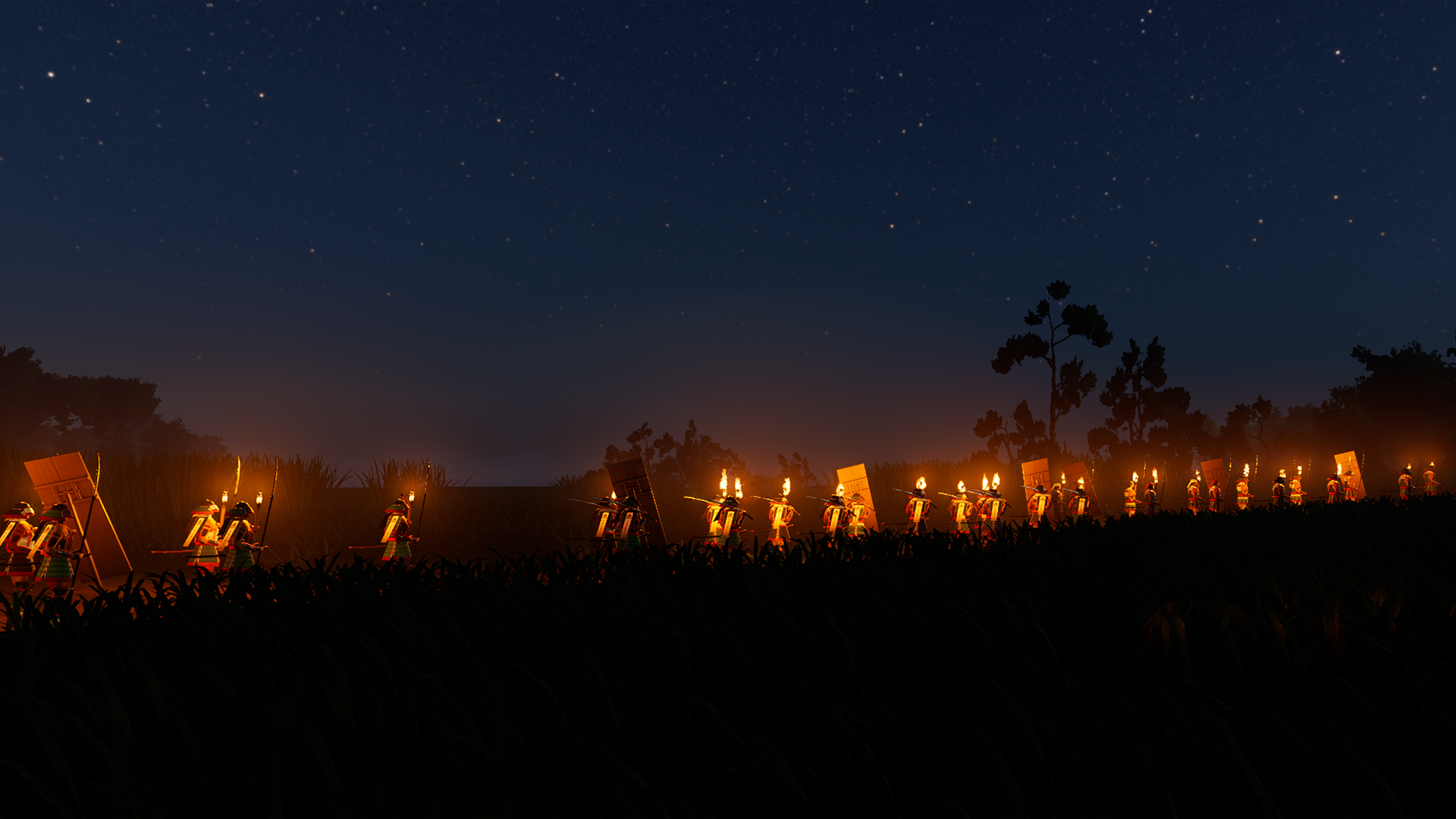
Wed, September 9, 2026
Jump into Awaji and experience medieval Japanese warfare like never before!
Warlords,
First, a message from me:
Thank you all for the support over these past 3 years of development and even before that with Warlord: Britannia. Darkmatter Games remains a single full-time developer leading an incredibly small team of skilled contractors. Warlord: Awaji is a fully handcrafted adventure made with the utmost care and attention to detail. Darkmatter Games has no outside investors or publishers. This is all possible thanks to YOU the player!
Today marks the end of a 3 year journey for me, and the beginning of a brand new adventure for you all. I hope you will have a blast playing! Whatever happens when this game launches, rest assured I will do my best to resolve issues quickly so that the maximum amount of people can play and enjoy the game.
Second, as Warlord tradition dictates, your in-universe launch message:
The Emperor's fledgling regime is on the brink of collapse. Rebel forces have taken over Awaji Island, and their powerful leader is returning from the West with a massive army to depose our Emperor in Kyoto.
Rumor has spread that the monks and warriors on Awaji have uncovered powerful, arcane weapons from a bygone war.
You are being sent to Awaji to defeat this rebellion and uncover the truth! If there is an advantage to be gained in this war, the Emperor wants it found!
Now set forth, and make for Awaji!
Darkmatter
#29
Steel Beasts Pro / Re: S B Videos Thread
Last post by Rinix - September 12, 2026, 02:43:07 AM #30
Games Discussion / Re: Tank Squad Tactical WW II ...
Last post by Asid - September 12, 2026, 12:03:12 AMDevelopment Status #95
Fri, September 11, 2026
Ponyri DLC, CPU Usage optimization, Game improvements, New tower
Dear Tankers!
Welcome to our 95th Development Status. We have some news from development of Ponyri but not only. We hope you will enjoy reading this dev status
Status report
We have continued our work on the game, now spending a few weeks pushing bigger fixes (mostly - optimization of vehicle physics and infantry animators - less CPU usage) + progressing the development of the Ponyri DLC (more about it below).
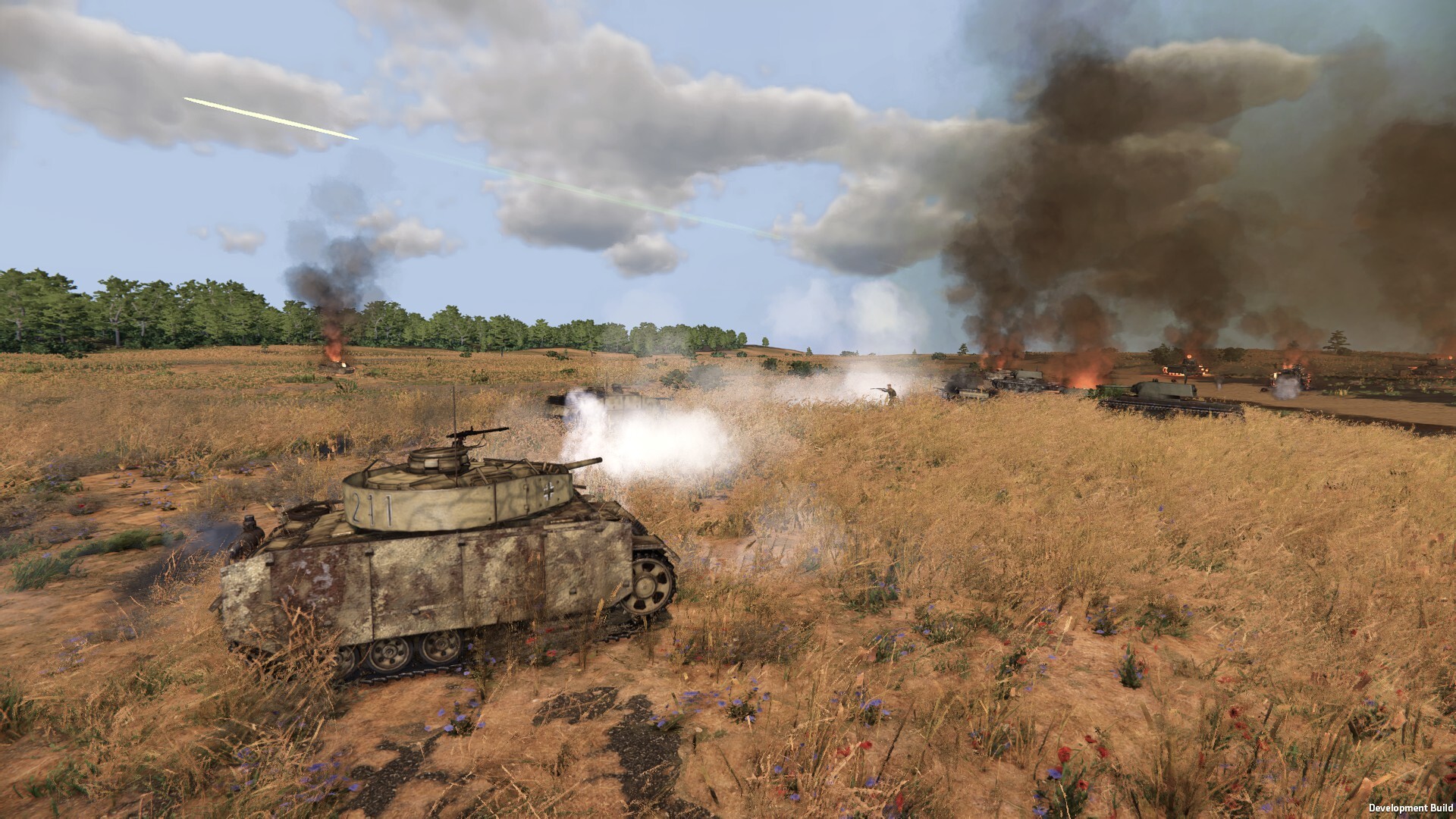
Ponyri - Sector 1 - Taginski
CPU Usage optimization
Our biggest CPU drain was and still is - vehicle physics. The more tanks are spawned on the scene and move, the more CPU they use + all that physics is being calculated on single core of the processor.
Now after having a small talk with our friend Marco, the main dev of Easy Red 2, we want to try and implement a physics LOD (level of detail) system. If a vehicle is far away from us (or static but closer) then it's physics will be turned off and switched to much more simple movement style.
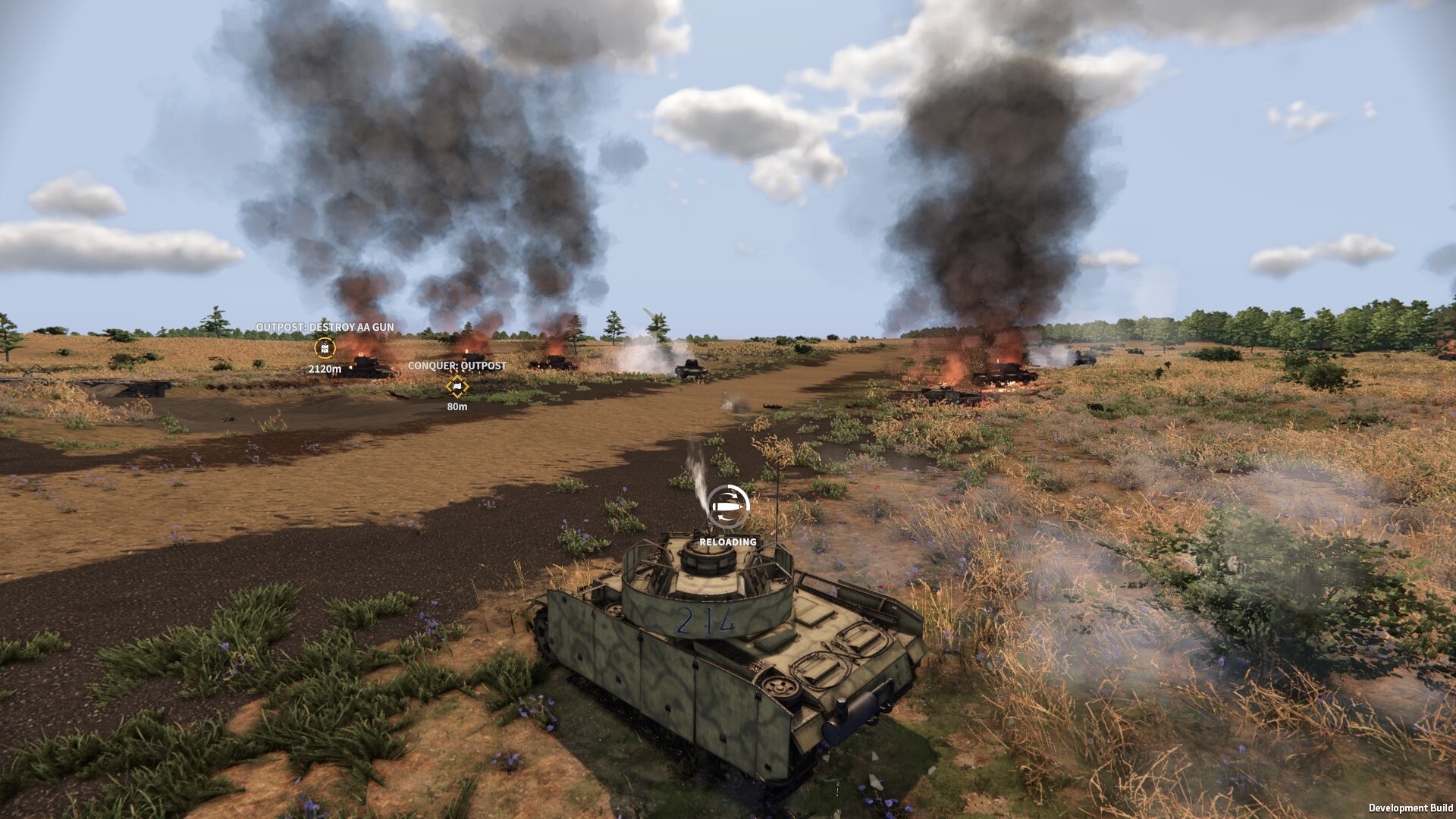
Ponyri - Sector 1 - Taginski
The player must not notice this change but the effect can be most visible on maps with big battles and active tanks at once.
Read on....
Fri, September 11, 2026
Ponyri DLC, CPU Usage optimization, Game improvements, New tower
Dear Tankers!
Welcome to our 95th Development Status. We have some news from development of Ponyri but not only. We hope you will enjoy reading this dev status
Status report
We have continued our work on the game, now spending a few weeks pushing bigger fixes (mostly - optimization of vehicle physics and infantry animators - less CPU usage) + progressing the development of the Ponyri DLC (more about it below).
Ponyri - Sector 1 - Taginski
CPU Usage optimization
Our biggest CPU drain was and still is - vehicle physics. The more tanks are spawned on the scene and move, the more CPU they use + all that physics is being calculated on single core of the processor.
Now after having a small talk with our friend Marco, the main dev of Easy Red 2, we want to try and implement a physics LOD (level of detail) system. If a vehicle is far away from us (or static but closer) then it's physics will be turned off and switched to much more simple movement style.
Ponyri - Sector 1 - Taginski
The player must not notice this change but the effect can be most visible on maps with big battles and active tanks at once.
Read on....